Correlations between Soil Sample and Soil Survey layers in the Soil Points tab provide insights into your fields and allow for the creation of new, useful continuous layers. See the article and video below to learn more.
Steps:
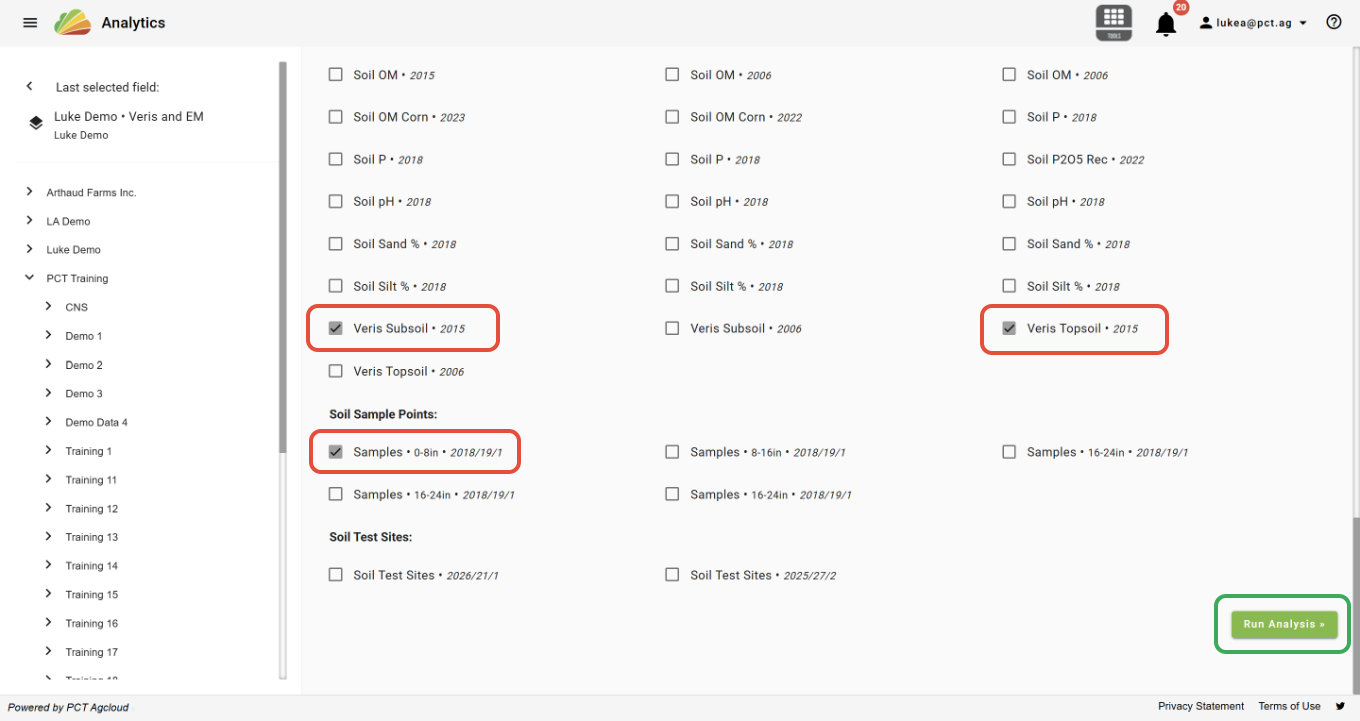
1. Select the Soil Sample Points and the desired layers from the list (Soil Survey layers are recommended for this tool, but other layer types are available for selection).
2. Then click 'Run Analysis'.
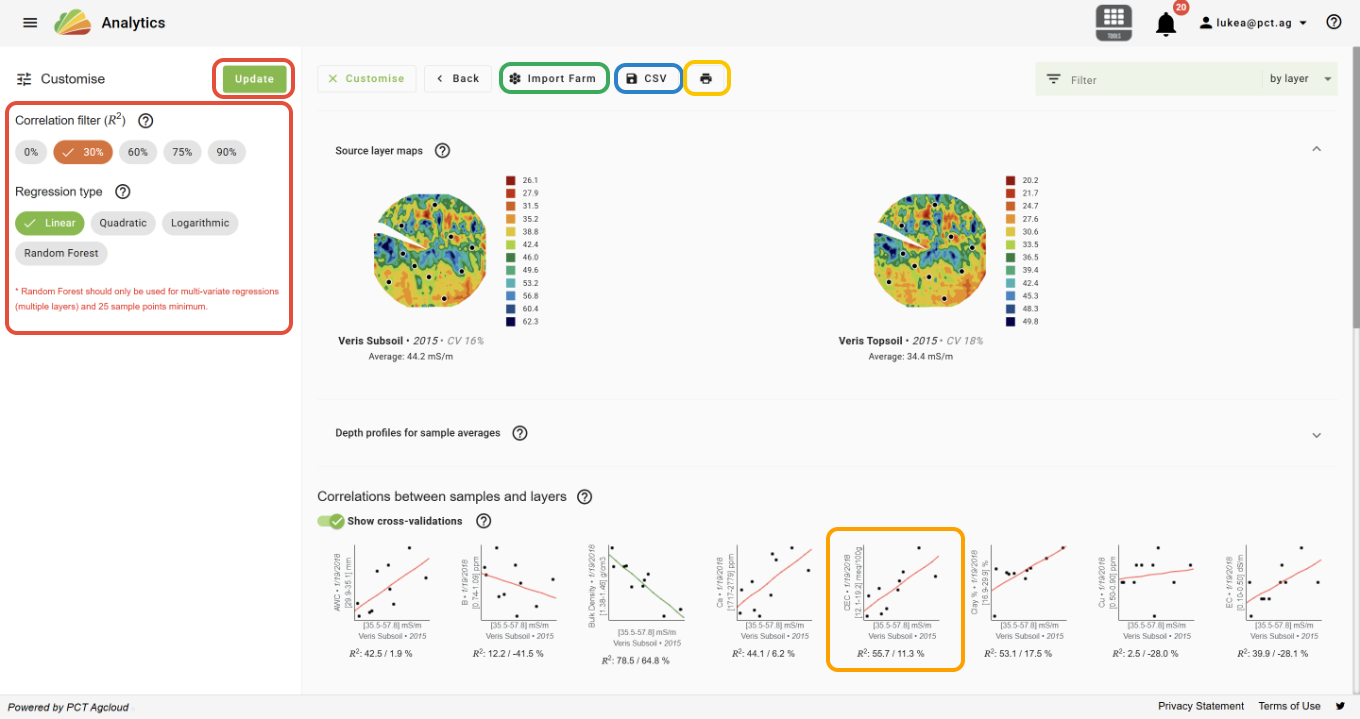
After clicking 'Run Analysis', the correlation results will appear. Calculations for Field Capacity, Wilting Point, Bulk Density, Hydraulic Conductivity, and Available Water Content are created automatically when the Soil Sample dataset contains Sand, Silt, and Clay measurements.
In each correlation, a red, orange, or green line is shown. If the line is red, the correlation is below 0.3 and a new layer can not be created. If an orange line is shown, the correlation is between 0.3 and 0.6 and a new layer can be created with caution. If a green line is shown, the correlation is above 0.6 and will allow a new layer to be created; however, caution should be exercised regardless of the degree of correlation.
3. Select a 'Correlation filter' to filter the result graphs that are displayed by an R-squared percentage, and select a 'Regression type' to change the type of equation used in the calculation. After selecting either of these options, click 'Update' to apply.
4. Select the 'Import Farm' button to import available Soil Sample data from the entire farm to be included in the analysis.
5. Click the 'CSV' button to download the correlation results in a CSV file.
6. Click the 'Print' button to print or download the correlation graphs as a PDF.
7. Click on a graph to display more options. Certain correlations support the creation of an estimated layer; these options can be displayed by clicking on a graph as well.
8. If multiple layers were selected, choose the layer that you would like to utilize.
9. If Soil Sample data for multiple depths was selected, toggle 'Depth Slices On' to select certain depths.
10. Click on a point in either the map or the graph to view the data for that point. The selected point will be highlighted in both the map and the graph.
11. Double-click on a point in the graph to remove it from the equation.
12. For correlations that allow the creation of an estimated layer, click 'Next' to move on. 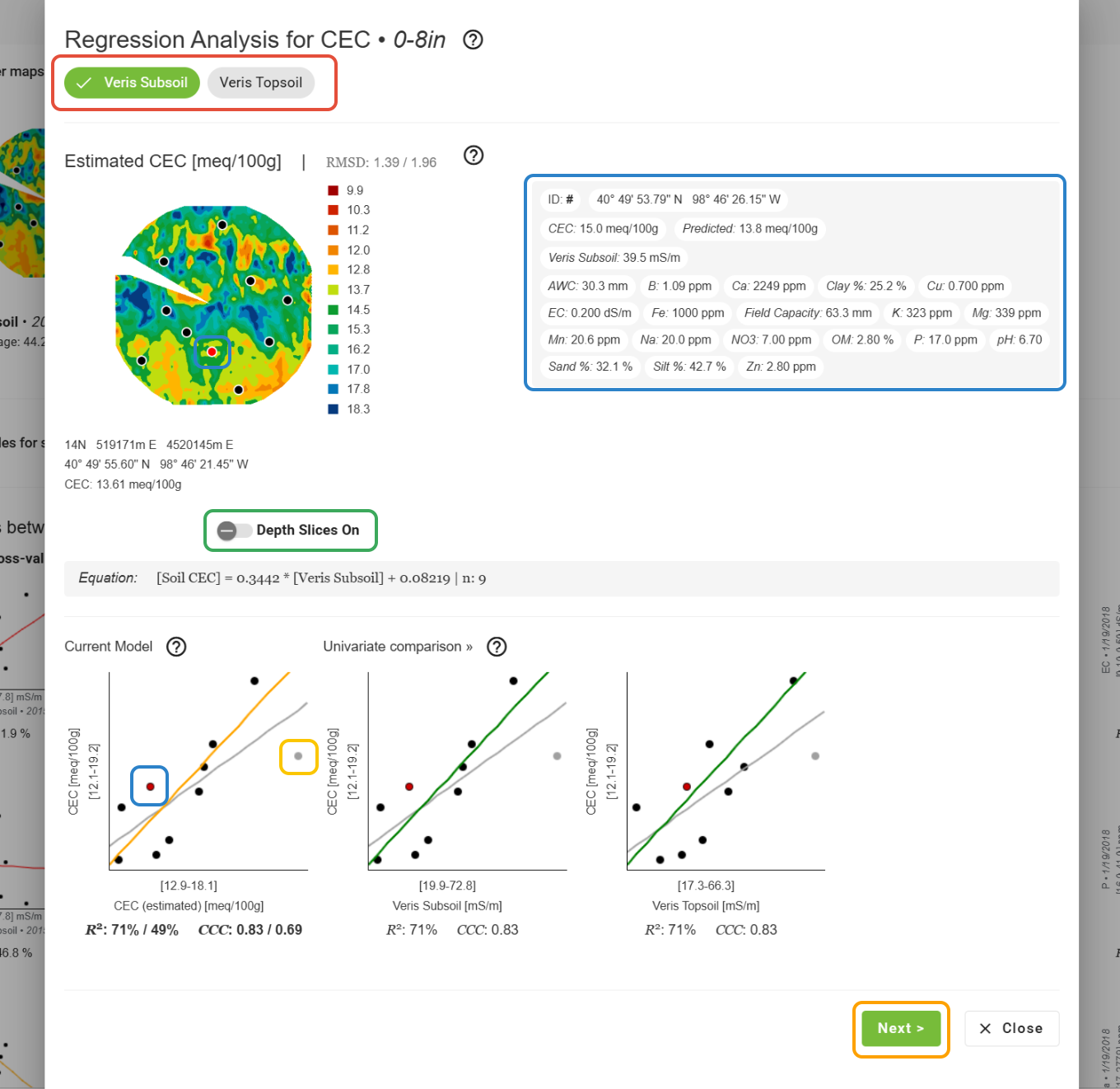
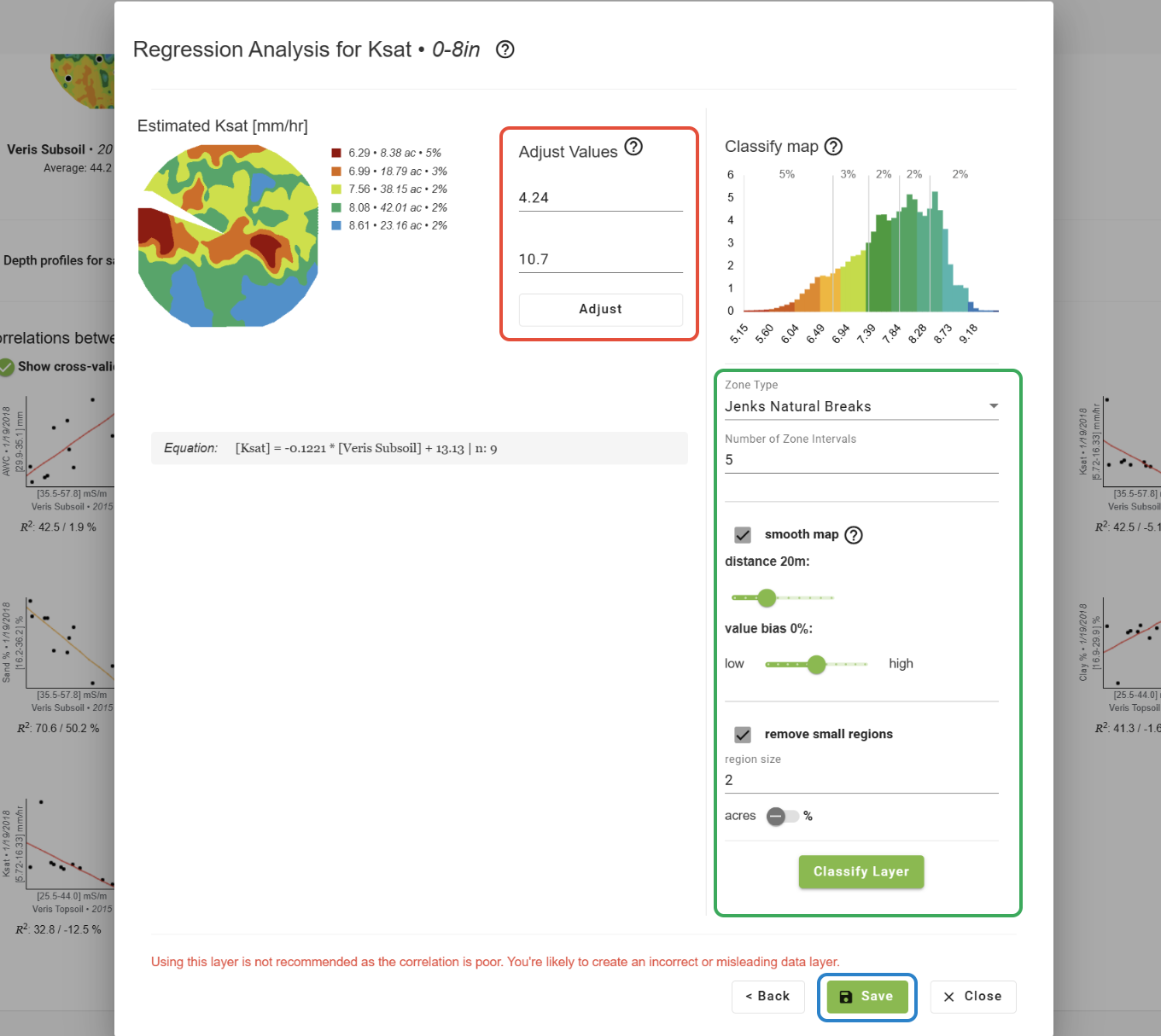
13. The layer values can be adjusted if needed. On occasion, the formulas can create irrelevant numbers (ex. numbers less than zero).
14. The layer can be zoned, but it is not necessary for saving.
15. Click 'Save'.
Was this article helpful?
That’s Great!
Thank you for your feedback
Sorry! We couldn't be helpful
Thank you for your feedback
Feedback sent
We appreciate your effort and will try to fix the article